College Enrollment: The Educational Future for Latinos
By Dean Trevino
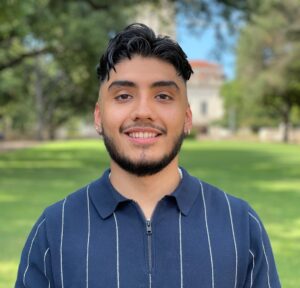
SAN MARCOS – As the U.S. continues to grow into becoming a majority-minority serving country, minority groups such as Latinos are largely under-represented in higher education.
Latino males are under-represented in higher education. There is a wide variety of reasons for this, including fear of financial burden, unfamiliarity with the college application process and heading directly into the workforce to provide their families with an additional source of income.
Gloria Martinez, Texas State sociology professor, believes that Latinos will be the economic future in the U.S. She also believes that if a critical mass of males aren’t going to college as a community, including the Latino community, that society will not see a growth in middle-class Latinos. Martinez said the gender gap amongst men and women in college needs to lessen for the sake of our future’s economy.
“Whenever you have a decline in college educated people, it has a negative effect on the growth of our economy in terms of growing up strong, middle-class economy, strong middle class within a particular group within the Latino community,” Martinez said.
“Whenever you have a decline in college educated people, it has a negative effect on the growth of our economy in terms of growing up strong, middle-class economy, strong middle class within a particular group within the Latino community,” Martinez said.
In 2011, the U.S. Department of Education designated Texas State as a Hispanic-Serving Institution. For Texas State to reach this designation, there must be an enrollment of at least 25% of undergraduate full-time Hispanic students. In Fall 2022, Hispanics made up for 40.5% of the student population. A nearly 13% percent increase from Fall 2012. An initiative for HSI’s is to provide Hispanic students with the necessary support to achieve higher education.
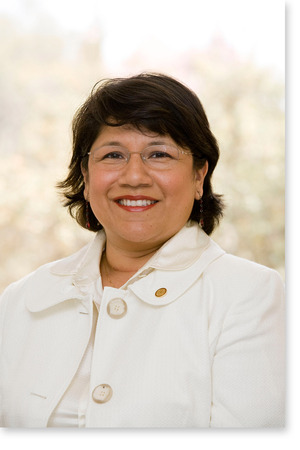
Gloria Martinez has taught Sociology at Texas State for over 15 years. The classes she’s previously taught were Latinos and Immigration and Latinas/os and Education. (Photo courtesy of Gloria Martinez)
Martinez said that there’s many reasons as to why Latinos are unable to enroll for college. The reason may include low funds and high tuition costs. She also said that there is a level of added stress for students who are first-generation and those who come from low-socioeconomic status.
Supporting Through the Educational Pipeline
According to Project MALES (Mentoring to Achieve Latino Educational Success), the educational future for Latino males is in a state of peril. Project MALES is a University of Texas at Austin organization created in 2010 by Dr. Victor B. Sáenz and Dr. Luis Ponjuán. They created Project MALES in response to data suggesting that Latinas are outpacing Latinos in the educational pipeline. Their mission is to conduct a mentoring program that provides Latino males and other men of color with the support to advance the educational pipeline with success.
Julio Bernal, Project MALES mentor coordinator, said that during his time as a mentor, he noticed that there isn’t a lot of motivation amongst men of color to enroll for college. He believes that this likely stems from a lack of understanding and exposure to what it is like to be a college student.
“So, there isn’t that like motivation and also there is a lot of support, especially cultural, culturally relevant support for men of color throughout the educational pipeline,” Bernal said. “I think there’s this assumption that these students should already know what to do and how to succeed, but no one’s really telling them how to go about, how to navigate institutions”
Rodrigo Aguayo, Project MALES program coordinator, believes that Latinos will become the backbone of the country, and that Texas is a representation of what the future of this country will become as a minority-majority state. He also believes that for Texas to achieve their goal with the 60×30 plan, they must focus on Latinos, especially Latino males.
“The Texas 60×30, so having 60% of the Texas population have a college credential by 2030, so within the next seven years, right, having more than 60% of Latinos between the ages of 25 or 34, to have a college degree,” Aguayo said. “And being a minority majority state means that you have to focus, that you want to reach those goals and metrics, you have to focus on your Latinos.”
Aguayo said that the college application process is what prevents many students from achieving a higher level of education. To boost enrollment amongst Latinos, Texas needs to provide their students with more support. This may include guiding Latinos through the application process and answering any questions they may have about it.

The 60x30TX Plan
Texas State’s Initiative
Gary Ray, Texas State associate vice president of enrollment management and marketing, said that a lot of men are skipping college and are going straight into the workforce. He believes this stems from a cultural issue within low-income households, in which the young men feel the need to provide their families with an additional source of income.
Ray said that Texas State’s goal is to expand the number of students that not only enroll, but also retain them and ensure that they graduate. He believes that this will help the state meet its 60×30 goal and make sure that Texas keeps growing from the standpoint of having a qualified, educated workforce that can meet the demands of the future.
“Equipping students from all various backgrounds with the right skills to meet the current demands or the future demands of the jobs of the future is critical to the social mobility and financial strength” Ray said.
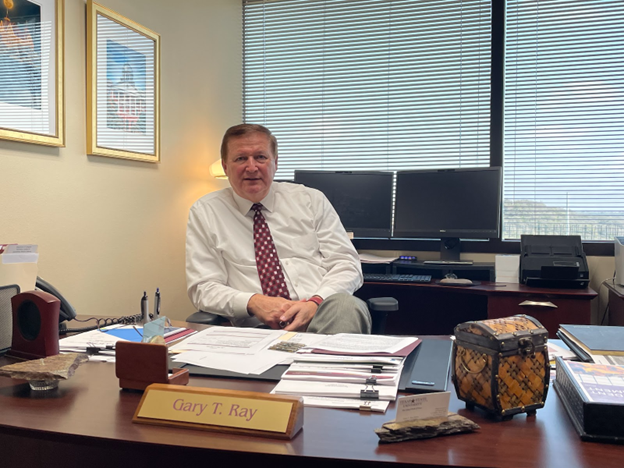
Gary Ray’s goal is to create a strategic enrollment and marketing plan for Texas State University. He’s also working to improve the graduation rates for students in a six-year period from 56% to 60%. (Photo Credit: Dean Trevino)
To achieve these goals, Texas State adopted a new test optional policy, this means that Texas State no longer requires ACT or SAT exams. Texas State has also put together Bobcat Promise, a financial aid package for students that come from disadvantaged backgrounds. With Bobcat Promise, Texas State will cover a student’s tuition and mandatory fees for all four years, given that they meet requirements.
Making An Impact
During a mentoring session at Kealing Middle School, Bernal said a young student named DeAndre approached him and said he was thankful for Bernal to remember his name. In that moment, Bernal realized that a simple gesture could make a significant impact on a student.
“For them to like, feel motivated enough to be like, I’m grateful that you learned my name. It just made such an impact for him,” Bernal said. “And so, I think that was the most impactful moment for me that I saw at Project MALES.”
